








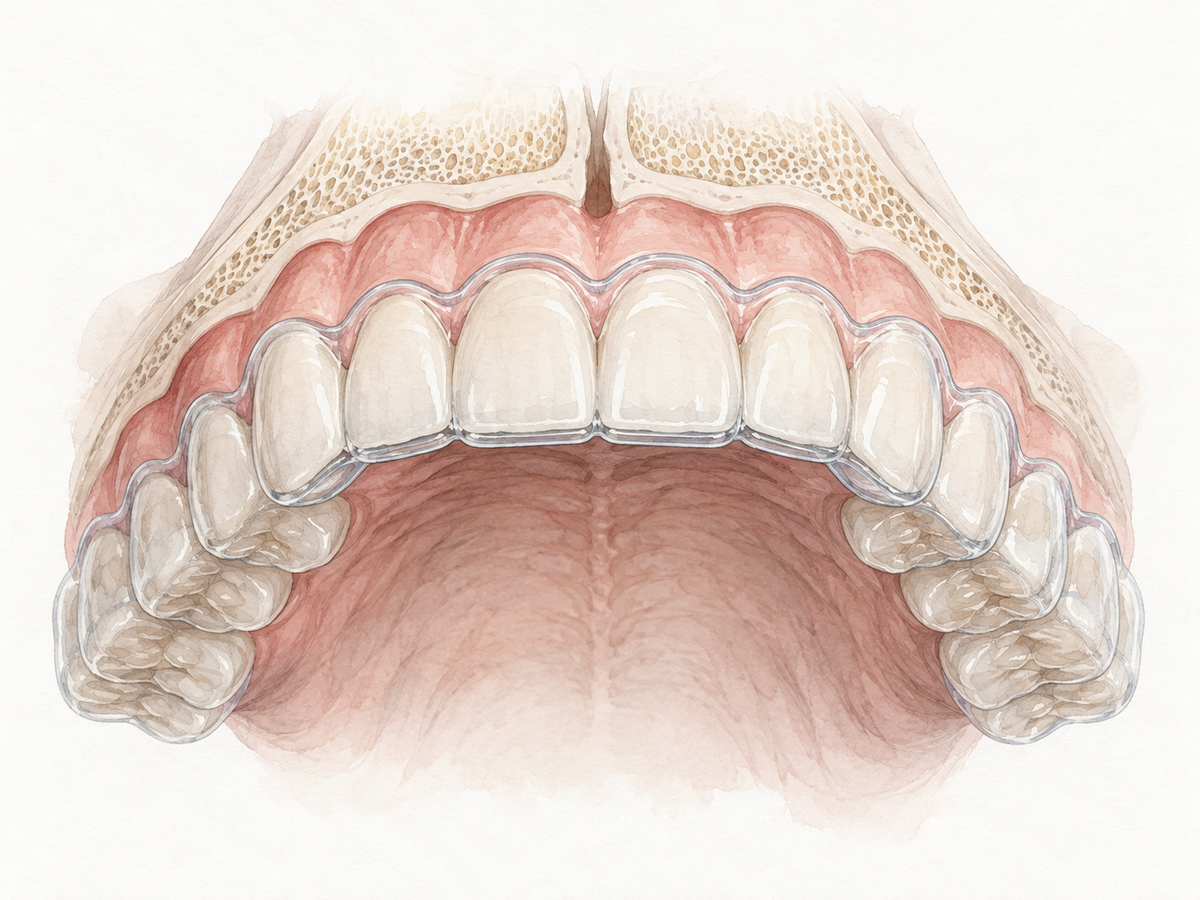
An Essix retainer is a clear, removable plastic shell that fits snugly over your teeth to keep them from shifting after braces or clear aligner treatment. It works as a passive retainer, which means it holds teeth in place rather than moving them. It may cover all of the teeth in one arch, or just the front teeth, and it is usually worn at night or on a schedule set by your orthodontist.
Treat it as a shield, not a straightener. If it cracks, feels loose, or causes pain, contact your orthodontist before teeth begin to drift.
How Essix Retainers Work
An Essix retainer is made by heating a thin clear plastic sheet and vacuum-forming it over a model of your teeth. That creates a custom-molded plastic shell that hugs the teeth closely.
Because the retainer is passive, it does not push teeth into new positions the way clear aligner treatment such as Invisalign does. Braces and aligners move teeth. The retainer simply keeps them there.
Teeth have a natural tendency to drift back toward their old positions after orthodontic treatment. That unwanted movement is called relapse. Almost everyone needs some form of retention after braces or aligners to reduce that risk, according to clinical guidance on orthodontic retention.
Coverage can vary. A full-coverage Essix retainer wraps across an entire arch, while a partial one covers only the front teeth. Your orthodontic needs and bite decide which style makes sense.
Types of Essix Retainers
The main styles include:
- Full-coverage Essix retainer: covers all teeth in the arch.
- Wrap-around design: plastic extends farther around the sides of the teeth, sometimes for a more secure fit.
- Partial Essix retainer: covers only the front teeth.
- Missing tooth space: the shell includes a gap where a tooth is absent so adjacent teeth stay in place.
- Combination with a bonded wire retainer: a thin wire is glued behind the teeth, and the clear retainer adds an extra layer of support.
Design details matter. Material thickness affects how the retainer feels and how long it lasts. Thicker plastic can be stronger but may feel more noticeable. Thinner plastic may feel lighter but can crack sooner. Trim lines, or where the plastic edge sits, also influence comfort and visibility.
Benefits and Limits
People often choose Essix retainers because they are:
- nearly invisible
- slim and comfortable
- easy to remove for eating and brushing
- often less expensive to make than some other retainers
In one randomized study, vacuum-formed retainers were more cost-effective than Hawley retainers over six months, and patients were often more satisfied with their appearance, according to research on retainer costs and patient satisfaction.
The limits are real:
- Plastic can stain, crack, or wear down with time.
- The shell can trap plaque against enamel if not cleaned daily.
- Heavy grinding can shorten its life.
- Some evidence suggests a higher failure rate than bonded retainers in some patients randomized trial on retainer stability.
Bruxism, or habitual teeth grinding, can cause extra wear. If you grind heavily at night, ask whether a night guard should replace or accompany the retainer.
Essix vs Other Retainers
Here is a simple comparison.
| Feature | Essix retainer | Hawley retainer | Fixed/bonded retainer |
|---|---|---|---|
| Visibility | Clear and barely visible | Visible wire and acrylic | Hidden behind teeth |
| Comfort | Slim, can feel tight | Bulkier | No daily removal, may irritate tongue |
| Durability | Can crack, stain, or wear | Repairable, long-lasting | Wire can come loose and need rebonding |
| Speech | May cause a brief lisp | May cause a brief lisp | Usually less impact after getting used to it |
| Hygiene | Removable, easy to clean | Removable, easy to clean | Harder to floss around |
| Cost | Often lower initial lab cost | Often higher initial lab cost | Can involve repair or rebond fees |
A Hawley retainer is the traditional removable retainer with a metal wire and acrylic plate. A fixed or bonded retainer is a wire glued behind the teeth.
Evidence suggests these choices are broadly similar for short-term alignment. A systematic review and meta-analysis found vacuum-formed retainers were about as effective as Hawley retainers for keeping arch width, length, and alignment. Over longer periods, a randomized trial found a fixed lower retainer kept lower front teeth slightly better than a removable clear retainer, but patients were generally satisfied with both perception study.
There is no universal “best” retainer. The right choice depends on your original bite, how likely teeth are to shift, oral hygiene, lifestyle, and what your provider recommends.
Cost and Insurance
Cost depends on:
- full-arch vs partial-arch coverage
- custom lab-made vs in-office fabrication
- material thickness and trim style
- replacement fees
- your location and provider
Prices vary widely. For example, a UK trial reported a vacuum-formed retainer fee of about €59 and a replacement fee of about €58 cost-effectiveness study. A separate hospital audit found replacement visits averaged about £255 in total audit on retainer replacement. In another European analysis, the material cost for a clear retainer was about €83, with total retention costs over two years around €778 per patient cost analysis of retention.
Do not assume dental insurance will not help. Coverage varies by plan. If the retainer is part of orthodontic treatment, your plan may pay a portion. HSA or FSA funds may also be usable if the expense qualifies. Ask about payment plans if the out-of-pocket cost is a concern.
Replacement fees are not always much cheaper than the original, so protect your retainer.
Care and Cleaning
A simple daily routine protects the plastic and your teeth:
- Rinse the retainer with cool water after removing it.
- Brush it gently with a soft toothbrush and mild dish soap or a retainer cleaner.
- Avoid hot water, bleach, and abrasive toothpaste.
- Store it in its case when it is not in your mouth.
- Never wrap it in a napkin or leave it in heat.
Odor and staining usually come from dried saliva, plaque, or colored drinks. A randomized trial found that adding cleaning tablets after brushing did not significantly lower bacteria compared with brushing alone, though tablets may help with odor and some bacteria cleaning trial. Avoid alcohol-based mouthwashes as a soak because one lab study found an alcohol-based mouthwash reduced the clarity of a copolyester retainer material retainer material study.
If grinding is a concern, do not rely on the retainer to do both jobs. Ask your orthodontist whether a night guard is the safer option.
Wear Schedule and Warning Signs
Wear time is personalized. Many orthodontists start with full-time wear for the first few days or weeks, then switch to nighttime wear. A systematic review of clear retainer protocols found no significant short-term stability difference between full-time and part-time wear in the studies reviewed. That supports a flexible schedule, but it does not mean skipping wear is harmless.
Teeth can shift if you stop wearing the retainer too soon. Relapse is unpredictable, so long-term night wear is a common way to keep results stable retention review.
Contact your orthodontist or dentist if you notice:
- a crack or hole
- a loose or unusually tight fit
- persistent pain or soreness
- gum irritation that does not settle
- visible tooth movement or new gaps
Replacing a worn or lost retainer is routine. Do not wait until teeth have already shifted.
Questions to Ask Your Orthodontist
Before you leave your appointment, ask:
- Am I a good candidate for an Essix retainer?
- How long should I wear it each day and for how many months or years?
- How much does a replacement cost?
- Does my dental insurance cover it?
- Would a fixed retainer or night guard also help my case?
- What cleaning products are safe for my retainer?
- What should I do if I lose or break it?
The most useful next step is to ask for a written retention plan with wear time, cleaning instructions, replacement costs, and follow-up visits. Then treat the retainer as what it is: a small, clear tool that protects the result you already worked for.
This article has been reviewed by an oral health professional for accuracy. It is intended to provide general educational information and should not be used as a substitute for personalized medical advice, diagnosis, or treatment. If you have questions or concerns about your oral health, please consult a dentist, physician, or other qualified healthcare provider.