









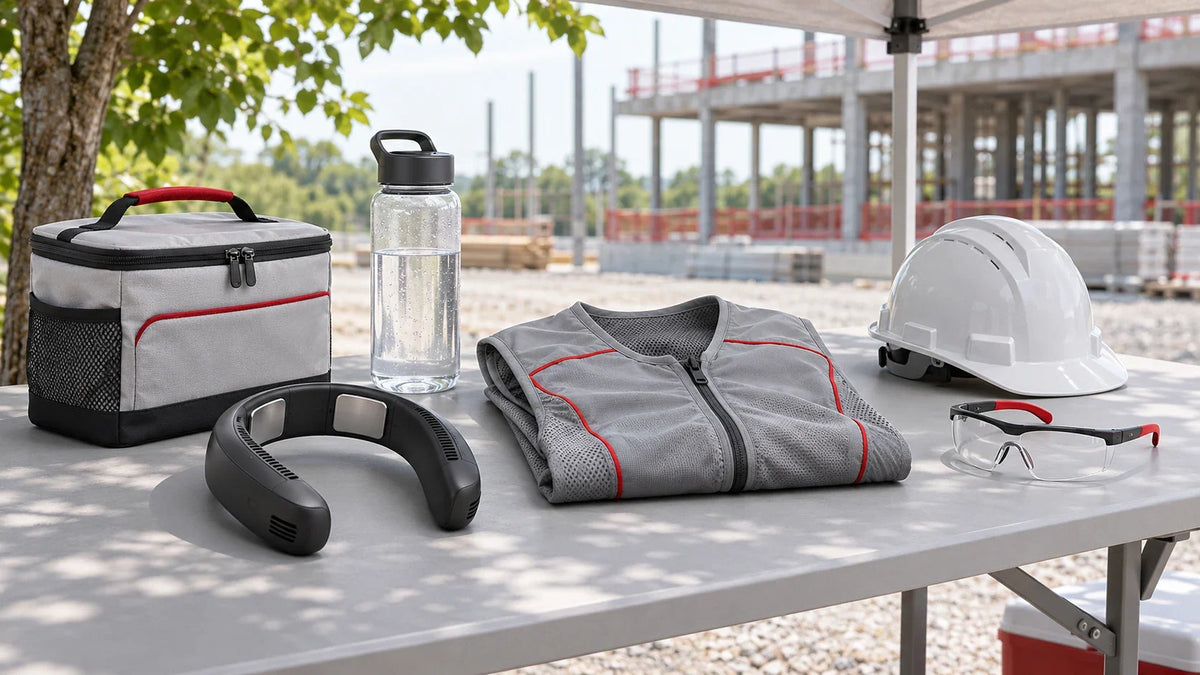
Choose equipment that fits the job, the protective gear and the whole shift.
The short answer: The best cooling gear depends on the task. Consider a cooling vest for torso coverage, a neck fan for lightweight airflow, or a neck air conditioner for powered contact cooling—after checking workplace approval, PPE fit and how you will recharge or refresh it.
A cooler neck can make a hot day feel more manageable.
It does not tell you whether the work is safe.
Construction workers, landscapers and other outdoor crews need equipment that works around hard hats, high-visibility clothing, dust and changing tasks. They also need a realistic way to keep that equipment useful after the first hour.
This guide compares product categories by work situation. It includes a PPE check, a shift-planning worksheet and questions for individual buyers and team purchasers.
It is a buying guide, not a tested ranking of individual products.
Start with the heat plan, then choose cooling gear
Outdoor work combines several sources of heat. The weather matters, but so do direct sun, nearby hot surfaces, physical effort and protective clothing. OSHA identifies these as factors when assessing workplace heat hazards. OSHA heat exposure overview.
That is why a weather-app temperature alone cannot select a safe working schedule.
Before buying equipment, ask who is responsible for the site's heat assessment and what happens when conditions change. A wearable should fit that plan.
Keep the essentials easy to reach
Water, a cooler rest area and appropriate breaks come first. OSHA recommends accessible cool drinking water and recovery in shade or a cooler place. Break frequency and duration should reflect conditions and workload. OSHA water, rest and shade guidance.
A shaded station at the far end of a large site may be inconvenient enough that workers delay using it. Plan access around where the crew actually works.
The equipment question comes next: what can improve comfort without adding a new obstacle?
Plan for new and returning workers
Experience on a construction site does not automatically mean someone is adapted to the current heat. NIOSH recommends gradually increasing exposure over 7–14 days and addressing reacclimatization after time away. A new cooling device does not replace that process. NIOSH acclimatization guidance.
Keep comfort separate from heat protection
A cold plate, a breeze or a fresh cooling pack can feel good immediately. That sensation alone is not evidence of a safe core temperature or a longer safe work period.
Treat consumer neck devices as optional comfort accessories unless the exact equipment has evidence and approval for a defined occupational application. Do not extend work periods because someone says the device feels cold.
The main types of cooling gear at a glance
There is no single best product for every crew.
Use this table to create a shortlist, then check the exact model's instructions.
| Type | Main cooling method | Useful feature to compare | What you need on site | Main buying limitation |
|---|---|---|---|---|
| Fan-only neck fan | Moves surrounding air around the neck and face | Low weight and adjustable airflow | Approved wearing position and charging access | No refrigerated air; airflow may be obstructed |
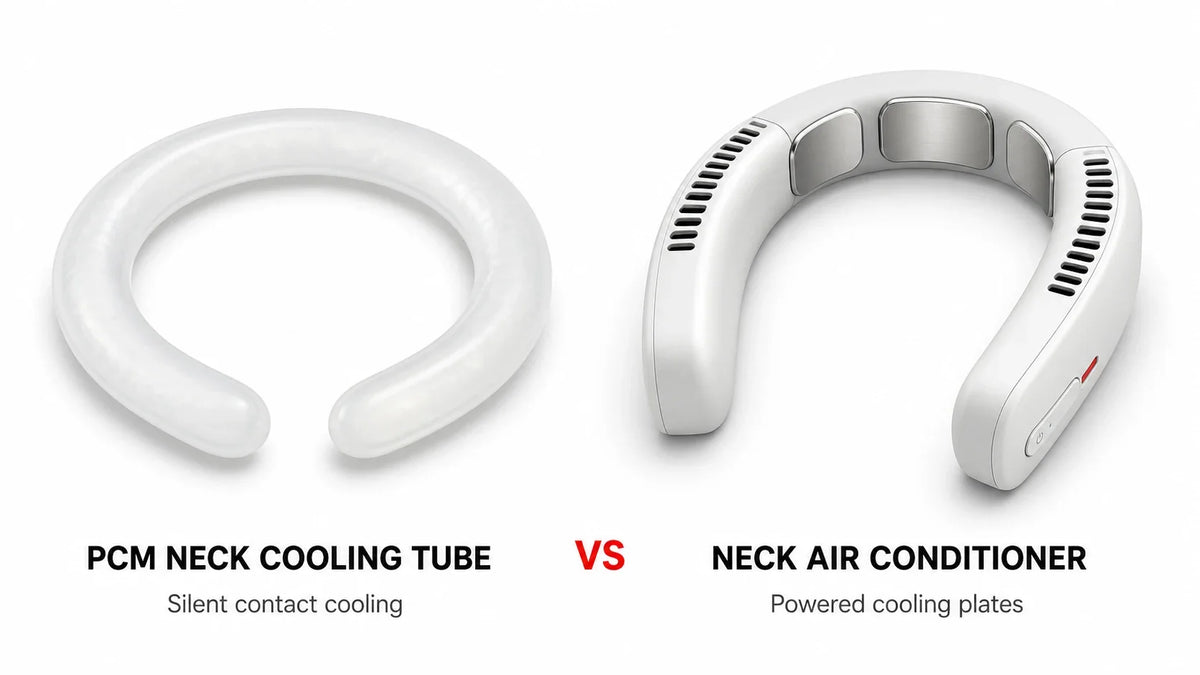
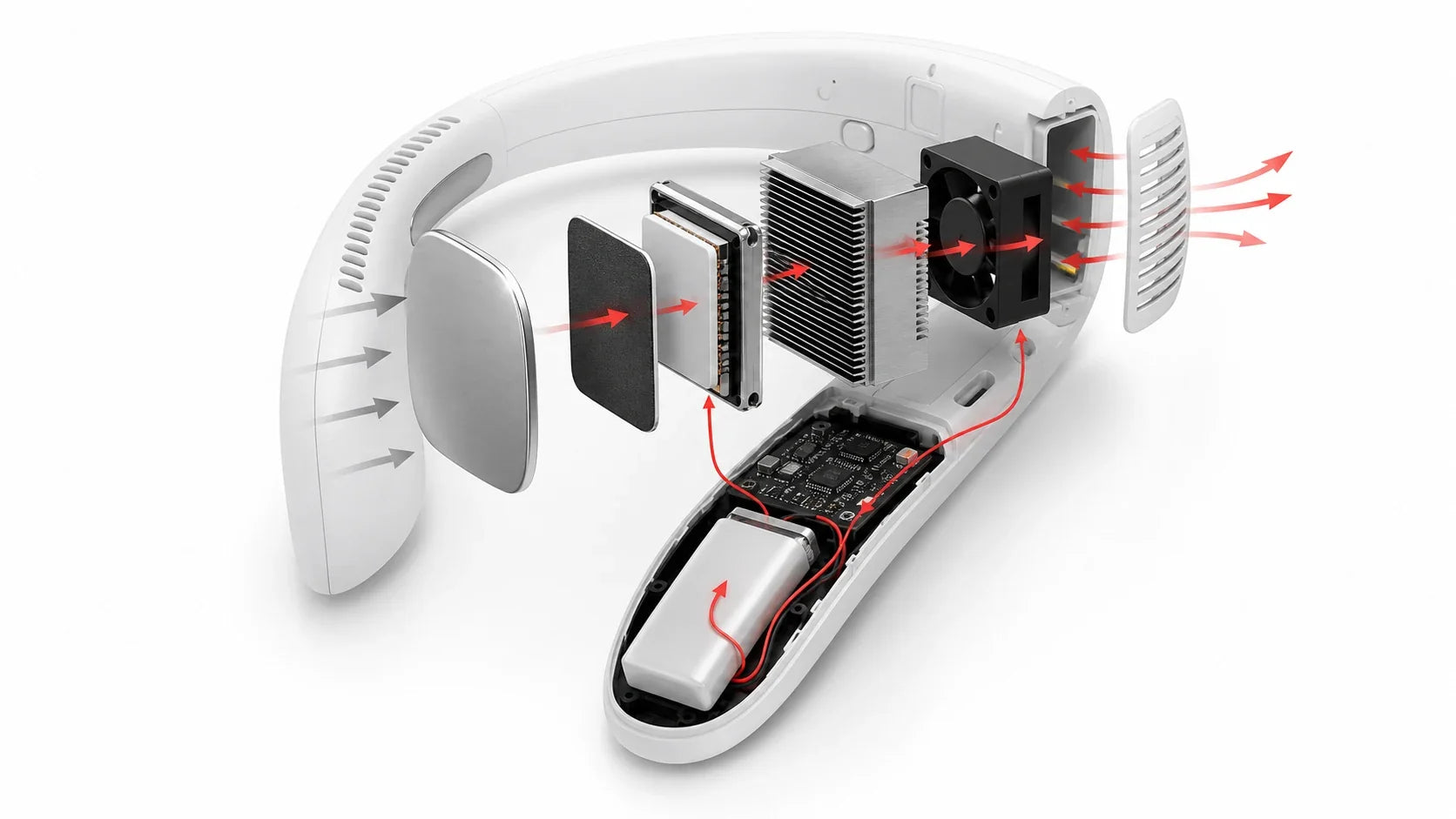
| Active-cooling neck air conditioner | Powered plates provide local contact cooling; fans reject heat | Adjustable cold contact without preparing frozen packs | Suitable skin contact, clear vents and charging access | Weight, noise and cooling-mode battery demand |
| Evaporative cooling vest or wrap | Water evaporates from wetted material | Easy water-based preparation | Clean water and conditions that allow evaporation | Dampness and weaker evaporation in humid or enclosed conditions |
| PCM or ice-pack cooling vest | Prepared packs absorb heat as they warm or change phase | Torso coverage and replaceable packs | Correct cold storage and a pack-rotation routine | Loaded weight and preparation time |
| Liquid- or air-cooled work system | Circulates cooled liquid or supplied air through a garment | Suitability for a specific occupational application | Compatible supply equipment and professional assessment | More complex equipment and possible movement restrictions |
Cooling garments vary widely. NIOSH notes practical limits such as weight, bulk, limited cooling duration and tethering in some systems. Category names alone do not establish job suitability. NIOSH PPE heat-burden guidance.
For preparation methods and the differences between evaporation and phase-change cooling, see Ergodyne’s cooling technology guide. Individual product instructions still take priority.
For an overview of smaller neck-worn options, see our neck cooling products guide.
Which cooling gear fits your work situation?
Start with the part of the day you want to improve.
Mobile inspection and light outdoor tasks
A compact neck device may be convenient when moving between locations and keeping both hands available matters.
Compare how it sits during walking, looking down and turning your head. Check the complete device weight rather than the weight of the battery or body alone.
A fan-only model may suit someone who mainly wants airflow. An active-cooling model adds a local cold contact point, with a different battery and weight trade-off.
Hands-free use still needs site approval. A device can interfere even when it occupies no hand.
Work with a pack-refresh station nearby
A cooling vest may deserve a place on the shortlist when torso coverage matters and workers can exchange prepared packs.
Before choosing a construction worker cooling vest, map out the refresh routine. Where are spare packs stored? How many can be prepared at once? Who returns used packs?
A good vest with no usable spare packs may become an ordinary extra layer later in the day.
Dry conditions with water available
An evaporative product may be practical when wetting and drying fit the task. Check whether damp fabric is acceptable around the work materials, electrical risks and required clothing.
Do not assume the same result in humid air or beneath clothing that restricts evaporation. Compare the preparation instructions and test the garment in the intended clothing arrangement.
Enclosed protective clothing or specialist hazards
Ask the site's safety professional to select a compatible system. A consumer fan placed inside protective clothing is not a substitute for that assessment.
NIOSH explains that some PPE traps heat and moisture and adds physical effort. The protective ensemble must be considered when evaluating heat exposure. NIOSH PPE heat-burden guidance.
Break-time use only
A device that is unsuitable near the task may still be useful in an approved break area.
Record that limit clearly. “For breaks only” is a different purchasing decision from “approved while operating equipment.”
Are neck air conditioners good for outdoor workers?
They can be worth considering for local comfort when the job permits them.
A fan-only neck fan moves air. A neck air conditioner with thermoelectric plates adds powered contact cooling. The distinction matters when comparing controls, weight and runtime. Our guide to how Peltier coolers work explains the mechanism.
What to look for
Prioritize fit and usable controls.
The plates should contact the intended area without pinching. Vents should remain clear of collars and straps. Controls should be reachable without distracting the wearer during a task.
Separate fan and cooling settings can help match comfort to the situation. Check whether the mode you want is available directly or only through an app.
For shared or team-issued equipment, consider whether every user can operate the device without a personal phone.
What to question
A very low plate-temperature claim does not describe the whole wearing experience. Ask about ambient conditions, whether the plate was touching skin and how long the setting was maintained.
Also question a runtime number that does not name the mode. A fan-only figure does not establish how long active cooling will run.
Neither a neck fan nor a cold plate creates a cooled work zone around the whole body. Do not use either as a reason to reduce other heat controls.
For electronic product options, use our neck fan and neck air conditioner buying guide. Check model documentation before selecting one for work.
Cooling vests: compare the complete wearing setup
Searches for the best cooling vests for workers often lead to very different designs.
Some rely on evaporation. Others hold ice or PCM packs. Some are designed for specialist supplied-air or liquid systems.
Compare the complete loaded garment, not just the empty shell.
Check the loaded weight and movement
Include every pack, cover and attachment in the wearing weight. Try the intended size over or under the clothing specified by the manufacturer.
Can the wearer reach forward, bend, sit and raise both arms? Does the vest press against tools or a seat back?
A garment that feels comfortable standing still may behave differently during repeated movements.
Check the preparation instructions
Ask what temperature, equipment and preparation time the packs require. Do not assume every PCM pack needs a freezer or every frozen pack is ready after the same interval.
Include spare packs and insulated storage in the budget. For evaporative designs, include the water supply, drying and washing routine.
Check visibility and protective compatibility
The phrase “cooling safety vest” does not by itself prove the garment meets the visibility requirement for the job.
Ask for documentation covering the exact model and wearing configuration. Check whether another garment or attachment covers reflective material. Do not alter required protective clothing to make a cooler fit.
Choose cooling wear as part of the full outfit, rather than as an isolated purchase.
PPE compatibility: try the complete outfit
A product photo rarely shows every strap and collar a worker uses.
Carry out an approved fit check with the actual equipment. The table below is a purchasing checklist, not a statement that any product has passed a safety test.
| Equipment or task | What to check | Reason to reject or restrict the cooler |
|---|---|---|
| Hard hat and chin strap | Look up, down and over both shoulders | Device contacts the suspension or displaces the strap |
| Safety glasses and face shield | Check head movement and shield travel | Cooler pushes equipment out of position |
| Respirator | Follow the respiratory-protection program's fit requirements | Device interferes with the seal, straps or required movement |
| High-visibility vest | Check the intended garment arrangement | Cooler or added clothing obstructs required visibility |
| Hearing protection and radio | Check communication using the normal setup | Device noise makes messages harder to understand |
| Harness, tool belt or backpack | Check approved movement and attachment clearance | Pressure, rubbing, blocked access or strap interference |
| High collar or hood | Check contact areas, intakes and exhaust | Fabric blocks vents or prevents comfortable fit |
| Moving machinery | Apply the task's snag and entanglement assessment | Wearing a neck device introduces an unacceptable hazard |
Never loosen a chin strap, move a respirator seal or modify a harness to accommodate cooling gear.
For dust, splashes, sparks or hazardous locations, request explicit manufacturer suitability information and site approval. A consumer water-resistance claim does not establish dust protection, electrical suitability or hazardous-location approval.
Will it last a full shift?
A shift is a schedule. A runtime claim is one operating condition.
Compare them directly.
Build a simple coverage worksheet
Suppose a team is planning an eight-hour day. The following worksheet is a planning example, not a work/rest recommendation or a measured product result.
| Part of the day | Question to answer | Evidence to collect |
|---|---|---|
| Before work | Is the device ready and approved for today's tasks? | Charge or pack-preparation check; condition inspection |
| First work period | Which mode or pack setup will actually be used? | Selected setting, loaded weight and start time |
| Each scheduled break | Does the setup need charging, exchange or cleaning? | Remaining charge, pack condition and refresh resources |
| Later work periods | Is the planned coverage still available? | Mode-specific remaining runtime or prepared spare supply |
| End of shift | Can everything be made ready for the next user? | Cleaning, drying, storage and recharge completion |
Write down intended wearing time separately from shift length. A device used only during breaks has a different coverage target.
Then ask for measured runtime in the exact setting you plan to use. Include room for variation; do not plan around reaching empty at the last minute.
Do not assume lunch solves charging
Charging time may be longer than the available break. A power bank does not automatically make wearing the device while charging acceptable.
Verify the model's instructions, charger requirements and allowed ambient conditions. Use a suitable dry charging area away from site contamination.
For cooling vests, the equivalent question is whether enough packs can be prepared before the next exchange. One spare set may not be enough if preparation takes longer than the interval between uses.
See our battery life and charging guide for comparing electrical runtime claims.
Dust, cleaning and daily handover
Include care in the purchase decision.
A cooler that takes too long to clean may be used less often. A shared device also needs a clear handover process.
Before buying, request the exact cleaning instructions. Ask which skin-contact parts can be wiped, which covers can be removed and what must remain dry.
Do not assume the whole device can be rinsed because it is worn outdoors. Do not improvise with solvents or compressed air unless the manufacturer permits them.
A practical daily checklist is:
- Inspect the housing, packs, straps and charging connection before use.
- Remove equipment from service if it is damaged, leaking or behaving unusually.
- Clean contact surfaces using the specified method.
- Let washable parts dry as instructed before storage or reuse.
- Identify who handles shared equipment and records problems.
For a dusty site, ask how the manufacturer expects intakes and exhaust openings to be maintained. If the cleaning method does not fit the site, choose another product or limit use to a cleaner area.
Individual buyer checklist
Start with the job restrictions before comparing prices.
- Approval: Can you wear this type of device during the task, during breaks or both?
- Fit: Does it work with your actual PPE and clothing?
- Comfort: Can you accept the loaded weight, contact pressure, dampness and noise?
- Coverage: Can you refresh it for the periods you plan to use it?
- Care: Can you clean and store it correctly after each day?
- Support: Are instructions, replacement parts and warranty terms available for the exact model?
If choosing electronic neck cooling, our neck air conditioner selection guide explains the features to compare.
Team purchasing: run a small pilot first
A bulk order should follow a workable daily routine.
Start with a representative mix of approved tasks, clothing sizes and PPE combinations. A supervisor wearing a device at a desk cannot establish whether it suits a mobile field crew.
Set acceptance criteria before the pilot. Useful records include:
| Check | Record |
|---|---|
| Wearing setup | Exact model, size, PPE and approved task |
| Conditions | Temperature, humidity, sun exposure and activity |
| Comfort | Pressure, movement, noise and reasons for removal |
| Coverage | Operating mode, start/end times or pack exchanges |
| Maintenance | Cleaning time, drying needs and damaged parts |
| Worker feedback | Whether the worker would choose to use it again |
These are field-evaluation records. They do not establish core-temperature reduction or heat-illness prevention.
Compare total program cost: purchase price, spare packs or devices, charging or cold storage, cleaning, replacement parts and staff time.
A lower unit price may be less useful if it requires infrastructure the site cannot provide.
For RANVOO team-purchasing discussions, prepare your expected wearing periods, PPE requirements, environmental conditions and charging access. Request documentation for the proposed model before committing to quantities.
Know when to stop work and get help
Cooling gear is not an emergency treatment plan.
Unusual fatigue, headache, nausea or dizziness during hot work needs prompt attention. Stop work, alert the supervisor and follow the site's response procedure.
Confusion, slurred speech, collapse or loss of consciousness can signal a medical emergency. In the United States, call 911 immediately, begin cooling with cold water or ice as appropriate and stay with the worker. Do not wait to see whether a neck device helps. Heat stroke can occur with heavy sweating. OSHA heat illness and first aid guidance.
Choose gear you can keep using correctly
The best cooling gear for hot weather is equipment that fits the work and can be refreshed throughout the planned wearing period.
Start with workplace approval. Check the complete outfit. Plan power, water or cold storage. Then compare comfort and total cost.