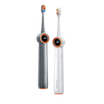
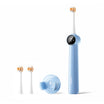


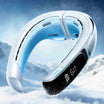
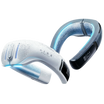





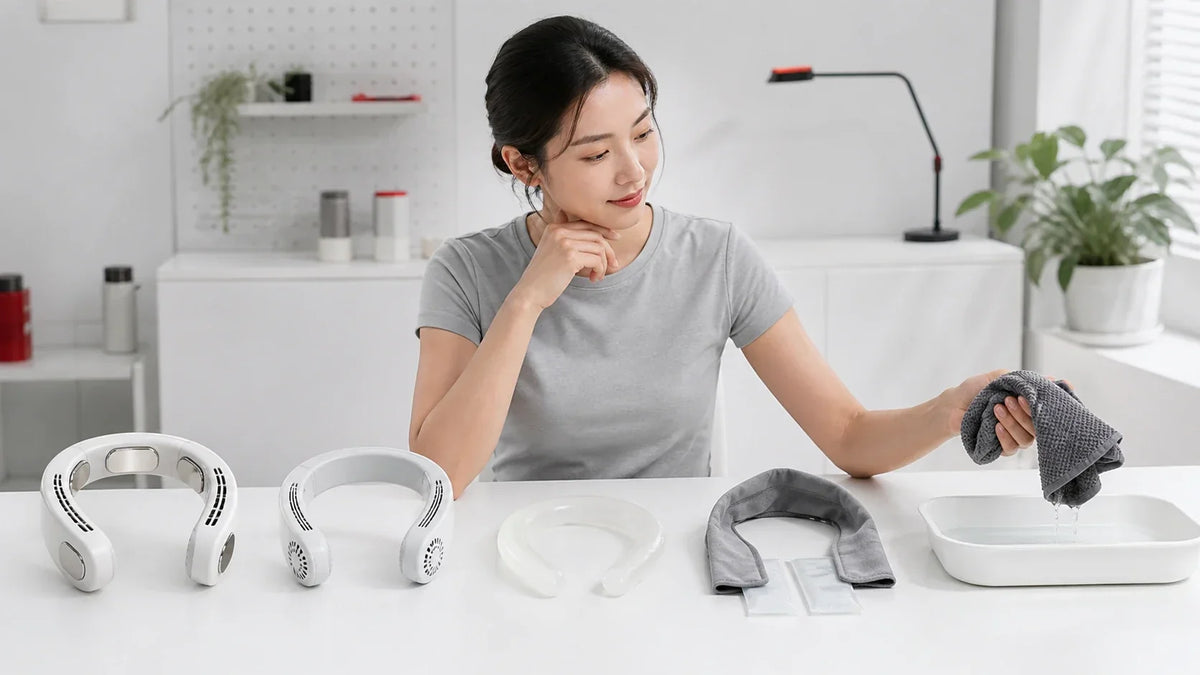
The short answer: Choose active cooling for repeatable cold contact, a neck fan for light airflow, a PCM tube for silent use, an ice wrap for short intense cooling, or a wet towel for the lowest cost.
A cooling neck wrap can mean several different products.
Some use water. Some use frozen gel. Some contain phase-change material. Others use fans or powered cooling plates.
They do not feel the same. They also need different supplies.
The right choice depends on five questions:
-
How long do you need cooling?
-
Will you have access to power, water, ice or a refrigerator?
-
Is the air dry or humid?
-
Can your clothes become damp?
-
How much weight and noise will you accept?
This guide compares five common neck coolers. It ranks the product types by use case. It does not rank individual models.
The five types at a glance
| Type | How it cools | Main advantage | Main limitation | Best fit |
|---|---|---|---|---|
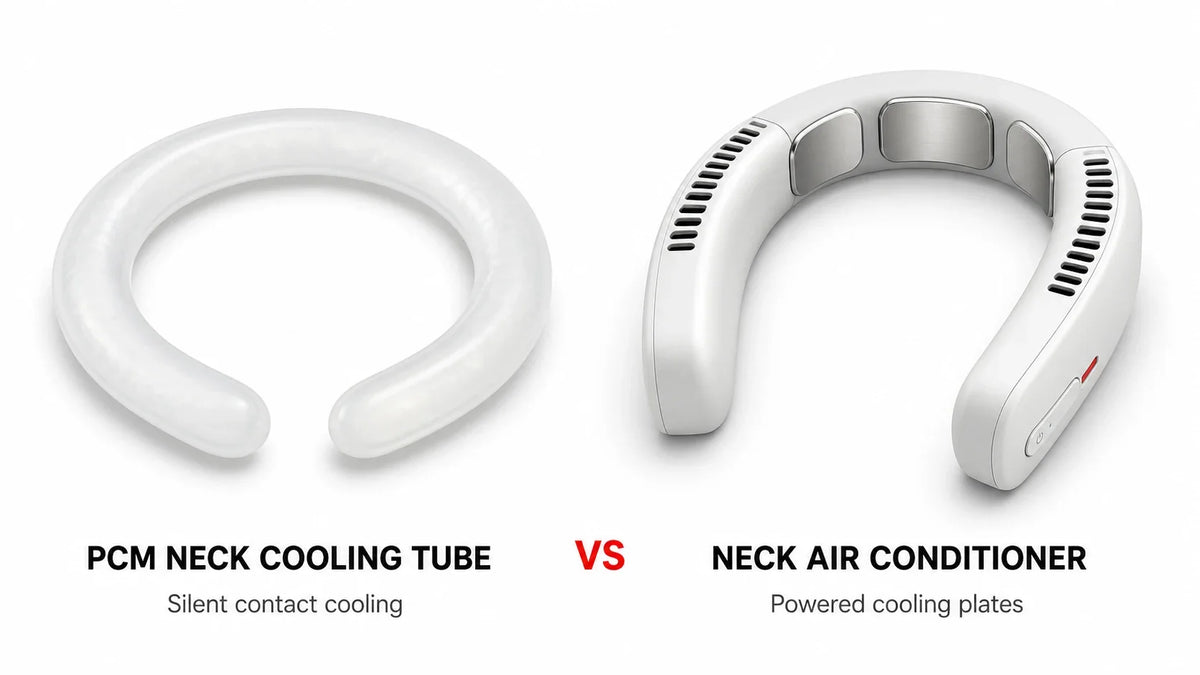
| Active-cooling neck air conditioner | Powered plates move heat away from the skin; fans release heat from the device | Repeatable cold contact while powered | More weight, noise and battery use | Long commutes, desk use and planned outdoor sessions |
| Fan-only neck fan | Moving air supports convection and sweat evaporation | Light, dry and easy to restart | Does not chill below the surrounding air | Walking, travel and everyday airflow |
| PCM neck cooling tube | Phase-change material absorbs heat as it changes state | Silent, dry and battery-free | Cooling fades until the tube is reconditioned | Quiet spaces, short trips and no-power use |
| Ice pack neck wrap | Frozen water or gel absorbs heat as it warms and melts | Strong initial cold sensation | Can feel too cold, become wet and lose effect | Short breaks and planned access to a freezer |
| Evaporative towel or scarf | Water evaporation removes heat from the wet fabric | Low price, low weight and no charging | Works less well in humid air and may wet clothing | Dry climates, exercise and low-budget kits |

No category wins every column.
Start with the resource you can restore. A battery can be recharged. A PCM tube can be cooled again. A towel can be rewetted. An ice wrap usually needs a freezer.

1. Active-cooling neck air conditioners
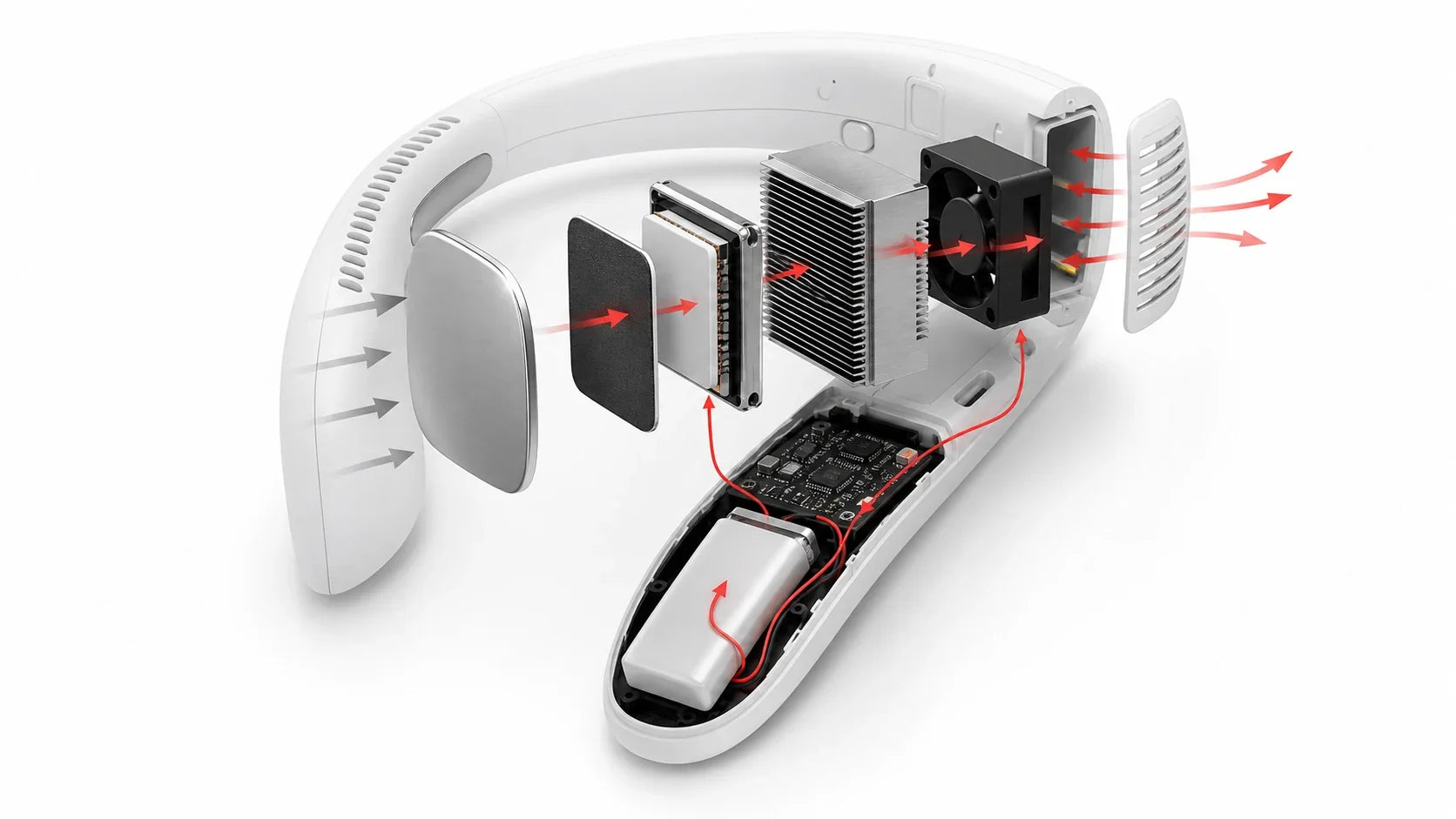
An active-cooling neck air conditioner uses thermoelectric plates.
The plates create a cool side and a warm side. The cool side touches the neck. A heat sink and fan move heat away from the warm side.[1]
This creates a direct cold sensation. It does not depend only on sweat evaporation.
That makes active cooling useful when you want a repeatable contact point. It can also remain noticeable in humid air.
There are trade-offs.
The plates, heat sinks, fans and battery add weight. Maximum cooling uses more power than fan-only operation. The motors also sit close to the ears.
Look for:
-
stable plate contact without pinching;
-
separate fan and cooling controls;
-
mode-specific runtime;
-
balanced weight;
-
clear charging requirements; and
-
an easy-to-clean contact surface.
Do not compare plate temperature without test conditions. An unloaded plate behaves differently from a plate touching warm skin.
For current electronic options, see our guide to the best neck fans and neck air conditioners.
Best for: people who value continuous, powered cooling more than minimum weight.
Skip it when: silence, low cost or zero charging matters most.
2. Fan-only neck fans
A neck fan moves the surrounding air.
It can disturb the warm air next to the skin. It can also help sweat evaporate.
Controlled research has found local comfort benefits from wearable face and neck airflow in defined warm indoor conditions.[2]
The surrounding environment still matters.
High humidity slows sweat evaporation. The National Weather Service notes that sweat evaporates less effectively as atmospheric moisture rises.[3]
A fan may still feel useful in humid air. But it does not create refrigerated air.
Check:
-
whether outlets reach the sides and back of the neck;
-
whether hair can cover the intakes;
-
low-mode noise;
-
ready-to-use weight; and
-
runtime at the speed you will actually use.
“Bladeless” usually means there is no exposed propeller. It does not mean there is no internal fan.
Read our full neck fan guide if you need help with airflow styles and fit.
Best for: dry comfort, low weight and longer fan-only sessions.
Skip it when: you expect a cold plate or below-ambient air.
3. PCM neck cooling tubes
A neck cooling tube contains phase-change material, or PCM.
The material absorbs heat as it changes from solid to liquid. During that change, its temperature can remain more stable than a simple frozen water pack.
This is why many cooling tubes feel gentler than ice.
PCM products are not identical.
The transition temperature, fill volume, tube shape and cover all affect the experience. One tube may reset in ice water. Another may require a refrigerator or freezer.
Check the exact instructions before buying.
Ask:
-
What temperature is required to reset it?
-
How long does resetting take?
-
What is the product weight?
-
Is the shell flexible at the start?
-
Can it be cleaned after sunscreen and sweat?
-
What should you do if the shell leaks?
NIOSH describes phase-change and ice-based systems as forms of personal cooling. It also notes that wearable cooling systems can be heavy, cumbersome or limited in duration.[4]
A best neck cooling tube is therefore not simply the coldest one. It should match your neck size, reset options and session length.
Best for: silent cooling without a battery or wet fabric.
Skip it when: you cannot recondition it between sessions.
4. Ice pack and cool pack neck wraps
An ice pack neck wrap uses frozen water, gel or another cold pack.
It often creates the strongest initial cold sensation in this comparison. The effect then declines as the pack warms.
Cold intensity is not the same as useful duration.
A very cold wrap can be uncomfortable. It may also create condensation. Thick insulation makes it gentler but can reduce heat transfer.
Use the supplied cover or barrier. Follow the product instructions. Do not place bare ice directly against the skin.
Public health guidance identifies numbness and color changes as warning signs of cold injury.[5] Stop using the wrap if the skin becomes painful, numb, unusually pale or discolored.
Before buying, check:
-
the frozen weight;
-
whether the pack stays flexible;
-
the cover material;
-
leak protection;
-
condensation control; and
-
access to a freezer between uses.
An ice wrap can work well during a short rest break. It is less convenient for a full day without cold storage.
Best for: short sessions when a freezer is nearby.
Skip it when: you have reduced skin sensation, dislike strong cold or cannot keep the wrap frozen.
5. Evaporative cooling towels, scarves and bandanas
A neck cooling towel holds water in or around its fibers.
As the water evaporates, it removes heat from the fabric and nearby skin.
The process is simple. Wet the item. Wring out excess water. Place it around the neck. Rewet it when the effect fades.
A cooling scarf or cooling bandana for neck use follows the same basic idea when water evaporation is the main mechanism.
These products are quiet. They are light when dry. They do not need a battery.
They can also make a collar damp. They need clean water. They may feel less effective when the air is humid or still.
Check:
-
wet weight;
-
fabric feel;
-
drying speed;
-
washing instructions;
-
odor resistance; and
-
whether dripping is acceptable for your clothing or equipment.
Do not leave a wet towel sealed in a bag. Wash and dry it according to the label.
Best for: dry climates, exercise and the lowest-cost cooling kit.
Skip it when: you need dry clothing or expect very humid conditions.

Which neck cooler is best for each situation?

Desk work
Choose active cooling if you want steady cold contact.
Choose a PCM tube if motor noise is unacceptable and you can reset it later.
Avoid a wet scarf if moisture near a collar or laptop is a problem.
Daily commute
A neck fan is easy to switch on and off. An active-cooling model adds stronger local cooling but weighs more.
Keep your ears open to announcements and traffic. Use the lowest useful setting.
Walking and light exercise
A light neck fan or cooling towel can work well.
Test bounce, hair clearance and wet weight before a long session.
A rigid tube may move during faster activity. Fit matters more than its size in a product photo.
Hot and humid weather
Do not rely on evaporation alone.
Active cooling can provide a clearer local sensation because the plates do not depend only on water evaporating. A neck fan may still help move air, but humidity reduces evaporative potential.[3]
Quiet or no-power environments
Choose a PCM tube, ice wrap or evaporative towel.
The decision is about resetting. PCM and ice products need cold storage. A towel needs water and airflow.
Outdoor work
Start with the worksite heat plan, not the wearable product.
NIOSH recommends engineering controls, work and rest schedules, hydration and cool recovery areas for occupational heat.[6] Personal cooling can support those measures. It does not replace them.
Check compatibility with helmets, hearing protection, high collars, straps and other PPE.
A practical buying checklist
Use the same questions for every product type.
Cooling method
Is it airflow, thermoelectric contact, evaporation, frozen gel or PCM?
Do not buy from the word cooling alone.
Useful duration
How long does it remain useful in the setting you care about?
For powered products, compare runtime by mode. For passive products, compare the full warm-up period.
Reset requirement
Does it need USB power, a refrigerator, a freezer, ice water or tap water?
How long does the reset take?
Humidity and moisture
Will high humidity weaken the mechanism?
Will the product wet your shirt, hair, backpack or PPE?
Weight and fit
Use wet or ready-to-wear weight.
Check neck opening, contact pressure and stability while walking and turning your head.
Noise
Electronic fans produce sound near the ears. Passive wraps and tubes are silent.
Test the useful setting, not only the quietest setting.
Cleaning
Look for washable fabric, wipeable contact surfaces and accessible vents.
Check how the manufacturer handles sweat, sunscreen, dust and storage.
Safety and support
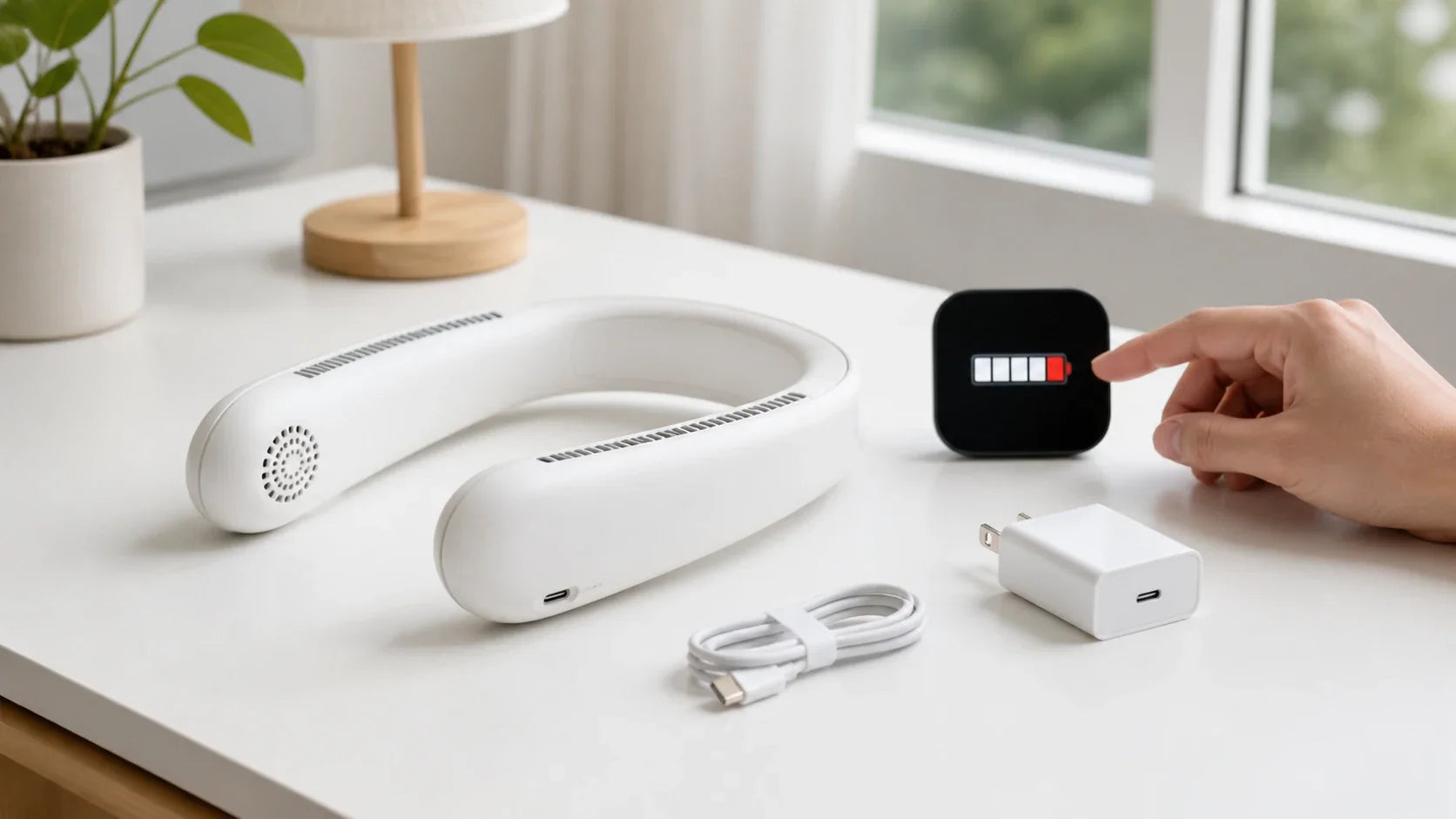
Use only the specified charging equipment for electronic products. Stop using any battery product that swells, leaks, smokes or becomes unusually hot.
For cold products, follow the skin-contact instructions. Stop if you feel pain, persistent numbness or see concerning skin changes.
Choose a seller with clear return and warranty terms.

How to compare products fairly
Category claims are hard to compare because each mechanism has a different endpoint.
A cold plate temperature is not the same as air speed. Air speed is not the same as towel evaporation. Initial temperature is not the same as useful duration.
Use one simple protocol:
-
Record room or outdoor temperature and relative humidity.
-
Weigh every product in its ready-to-use state.
-
Follow the manufacturer’s normal preparation instructions.
-
Test each product for the same session length.
-
Record comfort at 0, 15, 30, 60 and 90 minutes.
-
Note noise, moisture, movement and skin contact.
-
Record what is required before the product can be used again.
Do not compare only the first minute. Do not test bare cold plates and then describe the result as skin performance.
This article provides a category framework. Before publication, add same-condition measurements and original photos for the specific products included on the page.
Frequently asked questions
What is the best way to cool your neck?
Use active cooling for repeatable cold contact, a fan for light dry airflow, PCM for silent battery-free use, ice for a short strong cold sensation, or a wet towel for low-cost evaporative cooling.
How long do neck cooling tubes last?
There is no universal duration. It depends on the PCM, fill volume, starting temperature, ambient heat, body contact and insulation. Compare products under the same conditions.
Are neck wraps better than fans?
They are better when silence and no battery matter. Fans are easier to restart and do not require a refrigerator, freezer or wet fabric.
Do neck cooling towels really work?
They can improve local comfort when water can evaporate. The effect is usually weaker in humid, still air because evaporation slows.
Can I use a neck fan with a cooling towel?
The combination may increase evaporation, but keep water away from electronic intakes, charging ports and surfaces that the manual says must remain dry.
Is a neck cooler enough for extreme heat?
No. A neck cooler is a comfort aid. It does not replace shade, hydration, rest, acclimatization, appropriate clothing or emergency action for heat illness.
The bottom line
Choose by mechanism and reset conditions.
Active cooling offers repeatable cold contact. Neck fans offer dry airflow. PCM tubes offer silent convenience. Ice wraps offer short intense cooling. Wet towels offer the lowest entry cost.
Then compare weight, duration, humidity, moisture, noise and maintenance.
Next step: If you prefer an electronic option, use our neck air conditioner buying checklist before comparing models.
Sources
[1] Ferrotec, “Introduction to Thermoelectric Cooling,” Thermoelectric Technical Reference Guide.
[3] National Weather Service, “What Is the Heat Index?” accessed August 17, 2026.
[4] NIOSH, “PPE Heat Burden,” updated March 3, 2026.
[5] CDC, “Preventing Frostbite,” reviewed February 6, 2024.
[6] NIOSH, “Workplace Recommendations for Heat Stress,” reviewed August 12, 2024.