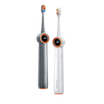
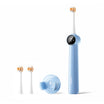


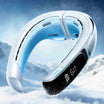






The short answer: Yes—neck fans can improve local comfort, but fan-only models move ambient air while active-cooling models lower only the skin they touch.
A neck fan can feel surprisingly effective. It can also feel disappointing. Both experiences are possible.
The reason is simple. Not every neck fan works in the same way. The environment also changes the result.
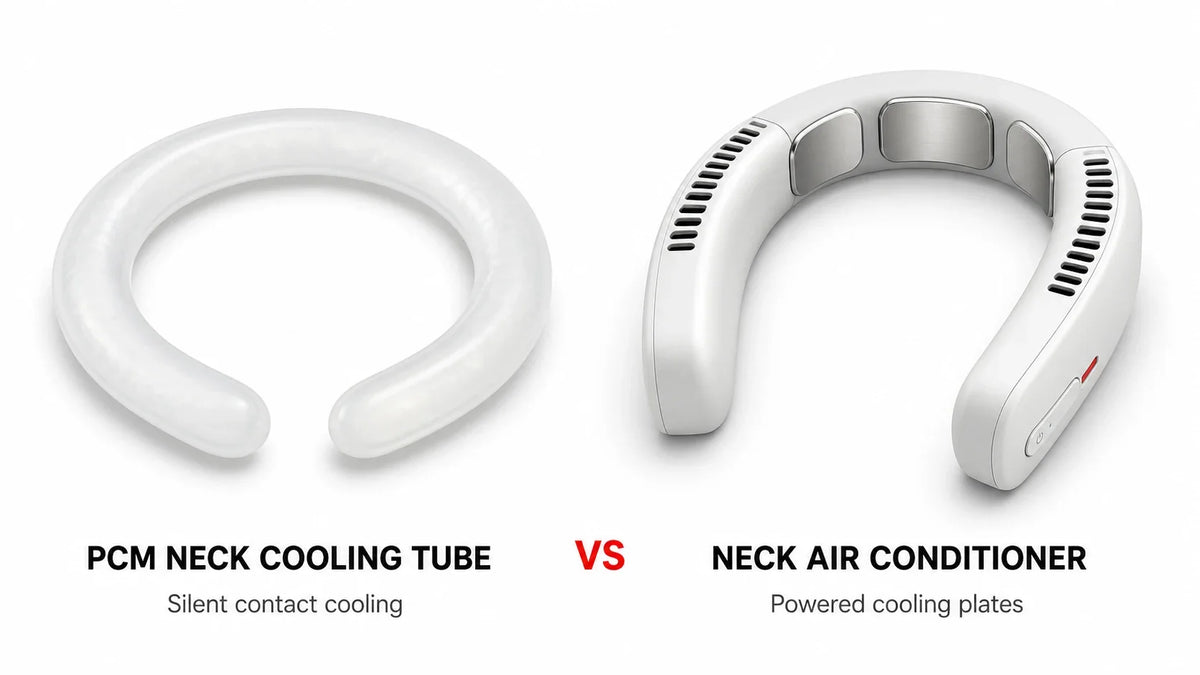
A basic neck fan moves surrounding air. It does not refrigerate that air. A neck air conditioner adds powered cooling plates. Those plates can create a colder contact point on the skin.
Neither type cools a room. Neither should be treated as medical protection from heat illness.
This guide separates three different outcomes:
-
feeling cooler;
-
lowering local skin temperature; and
-
lowering core body temperature.
These outcomes are not interchangeable. That distinction matters more than any marketing phrase.
Why a neck fan can make you feel cooler
Most neck fans use small electric blowers. The blowers pull in room air and direct it toward the neck, jaw or face.
The air is usually not colder than the room. The moving air still changes how heat leaves your skin.

Airflow removes the warm layer next to your skin
Still air forms a thin, warm layer close to the body. A fan disturbs that layer. Fresh surrounding air takes its place.
This can increase convective heat transfer when the surrounding air is cooler than the skin. It also reduces the stuffy feeling around the collar and jaw.
Placement is important. Air that reaches the skin can help. Air that escapes behind the device may do very little.
Hair and clothing matter too. Long hair can cover outlets. A high collar can redirect the flow. A backpack strap can partly block an intake.
Airflow can help sweat evaporate
Evaporation removes heat from the skin. Moving air can support that process by carrying moist air away from the body.
This is why a fan often feels stronger after you begin to sweat. It is also why the same fan may feel weaker on a humid, windless day.
Humidity is only part of the story. Air temperature, clothing, sweat rate and airflow all interact. Research on larger electric fans shows that moving air can help or hurt under different combinations of temperature and humidity.[3]
Do not reduce that evidence to one universal temperature cutoff. A small neck fan is not the same as a large room fan. It also covers much less skin.
The neck and face are sensitive cooling zones
The neck and face make up a small share of the body. Yet cooling these areas can strongly affect comfort.
A controlled 2021 study tested wearable face and neck fans with 16 young adults. The room was set to 30°C or 32°C. Relative humidity was 50 ± 5%. Background air speed was 0.1 m/s.[1]
The devices improved thermal sensation and comfort. They also reduced local skin temperature at the measured areas. The largest reported local reduction was 2.1°C.
That result supports a real comfort effect. It does not prove that every neck fan will produce the same change. The tested devices, airflow, fit and room conditions were specific to that study.
What cooling plates change
Some products add metal cooling plates. These models are often sold as neck air conditioners.
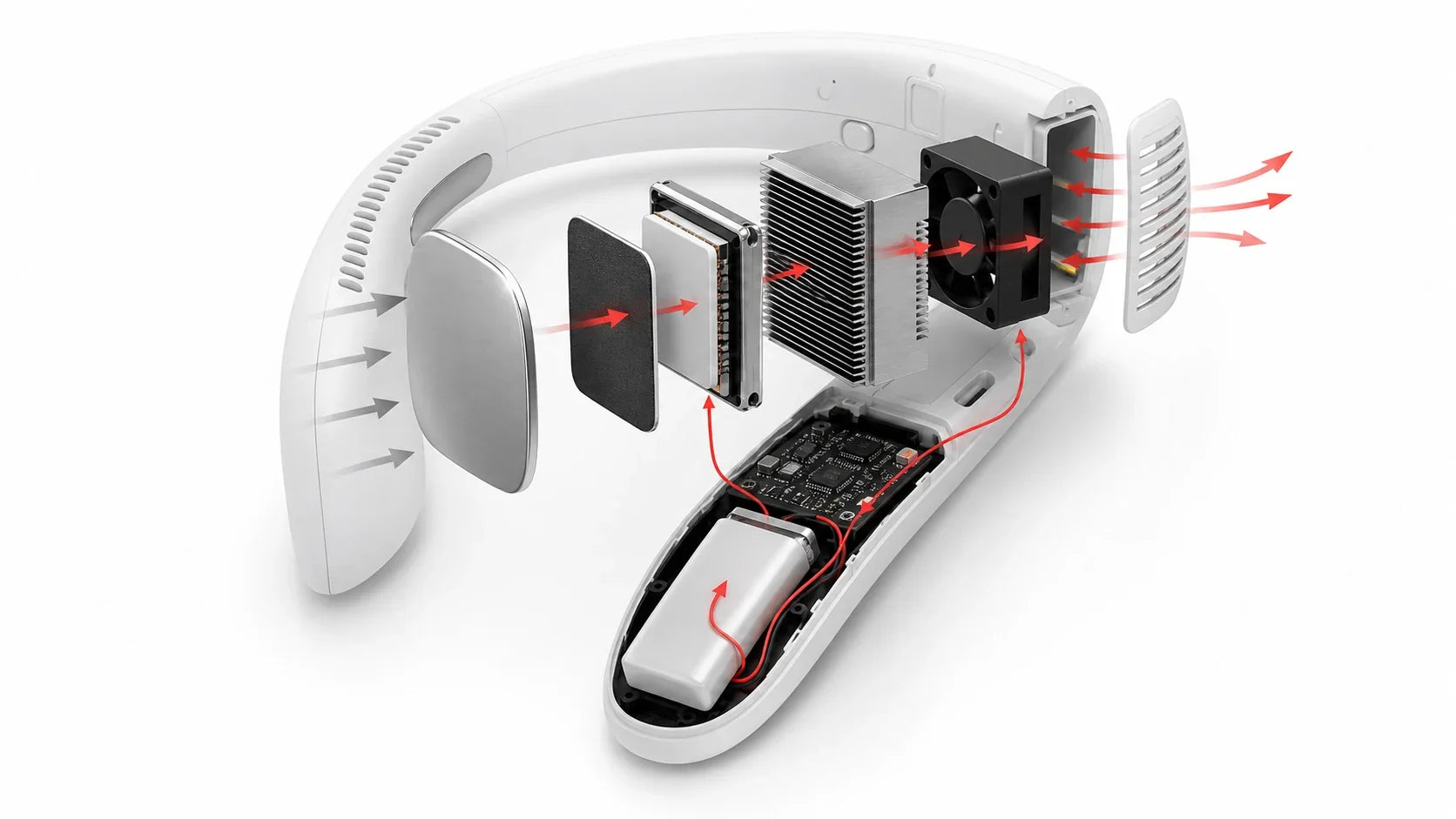
The plates use thermoelectric modules. Electricity moves heat from the skin-facing side to the hot side of the device. A heat sink and fan then release that heat into the surrounding air.

This creates a different sensation from airflow alone. The plate can feel cool even when you are not sweating. It can also stay noticeable in humid air.
For a closer look at the heat path, read how a Peltier cooler works inside a wearable device.
Cooling plates act on a small contact area
A cold plate can lower temperature where it touches the skin. It does not directly cool the arms, legs or torso.
Contact quality matters. A gap between the plate and neck reduces heat transfer. Too much pressure can become uncomfortable.
The plate also needs a stable hot-side system. If the heat sink cannot release heat fast enough, the cold side may warm during use.
This is why a lowest plate temperature is not enough. Buyers also need the loaded temperature over time. They need the ambient conditions and power mode too.
A cooler neck does not prove a cooler core
Local comfort is useful. It is not the same as a lower internal body temperature.
A 2025 randomized crossover trial makes this difference clear. Fourteen healthy men exercised in a 35°C room at 50% relative humidity. In one condition, they wore a neck cooler containing 1,200 grams of ice.[2]
More participants felt cooler with the neck cooler. Yet the researchers found no significant difference in rectal temperature, esophageal temperature, forehead skin temperature or sweat loss at the end of the trial.[2]
The device in that study was an ice-based collar. It was not a consumer neck fan. The result should not be used to rank a specific product.
It still illustrates an important rule: a strong cool sensation does not guarantee a lower core temperature.
What cooling tests show so far
The current evidence supports a careful answer.

| Question | What the evidence supports | What it means for buyers |
|---|---|---|
| Can a neck fan improve comfort? | Yes, under tested warm indoor conditions.[1] | Expect a local comfort tool, not room cooling. |
| Can airflow lower local skin temperature? | It did in a controlled study at 30°C and 32°C.[1] | Results depend on outlet position, fan speed, fit and environment. |
| Can cooling plates feel colder than fan-only airflow? | Yes. They actively move heat away from a contact surface. | Check plate contact, hot-side airflow, power and runtime. |
| Does neck cooling lower core temperature? | Not reliably. One 2025 exercise trial found no significant core-temperature benefit.[2] | Do not treat comfort as proof of heat-illness protection. |
| Will every neck fan work in high humidity? | No universal result exists. Humidity affects evaporation, while temperature, airflow and clothing also matter.[3] | Compare tests performed in conditions close to your own. |
| Can a neck fan replace air conditioning? | No. It cools one person locally and does not remove heat from a room. | Use room AC, shade or another heat control when the environment itself must be cooled. |
This is also why product reviews should separate fan-only and active-cooling models. The mechanisms are different. The weight, power use and sensation are different too.
Our best neck fan guide uses that separation before comparing fit, noise and battery life.
How we evaluate whether a neck fan works
A useful test needs a control. It also needs stable conditions.
Turning on a product for ten seconds is not enough. Pointing a thermal camera at a shiny metal plate is not enough either.

The following protocol is designed for product testing. It does not create a medical result.
Evidence note: RANVOO product test data was not supplied for this article. We therefore do not publish an invented temperature drop, winner or “our tests show” claim.
1. Record the room conditions
Log air temperature and relative humidity for every run. Measure background air speed too.
At minimum, use three environments:
-
a warm indoor condition at 30°C and 50% relative humidity;
-
a warm, humid condition at 30°C and 80% relative humidity; and
-
a hotter condition at 35°C and 50% relative humidity.
Keep the room stable before each run. Record any sunlight or radiant heat source.
2. Use an off-device control
Measure the same wearer or skin simulator with the device turned off. Then repeat with fan-only and active-cooling modes.
Randomize the order where possible. Give the test surface time to return to baseline.
Without a control, normal temperature changes can look like product performance.
3. Measure airflow at the skin
Use an anemometer at fixed points around the neck and lower face. Record the distance and angle.
Do not measure only at the outlet. The important question is how much air reaches the wearer.
Repeat the test with typical hair and clothing positions. Note any blocked intake or vent.
4. Measure local temperature over time
Place contact sensors at defined skin or simulator points. Include the back and sides of the neck.
Record the baseline. Then record at 1, 3, 5, 10 and 20 minutes.
For a cooling-plate model, measure both the plate and the contact surface. Record the hot-side or exhaust temperature as well.
Thermal images can show heat distribution. Use a contact sensor to validate important values. Reflective metal can mislead an infrared camera.
5. Ask how the wearer feels
Temperature does not capture the whole experience. Use the same simple rating scale in every run.
Ask about overall warmth, neck comfort, face comfort and dryness. Add pressure, balance and noise.
Collect ratings after the same amount of time. Do not ask only at startup.
6. Test practical performance
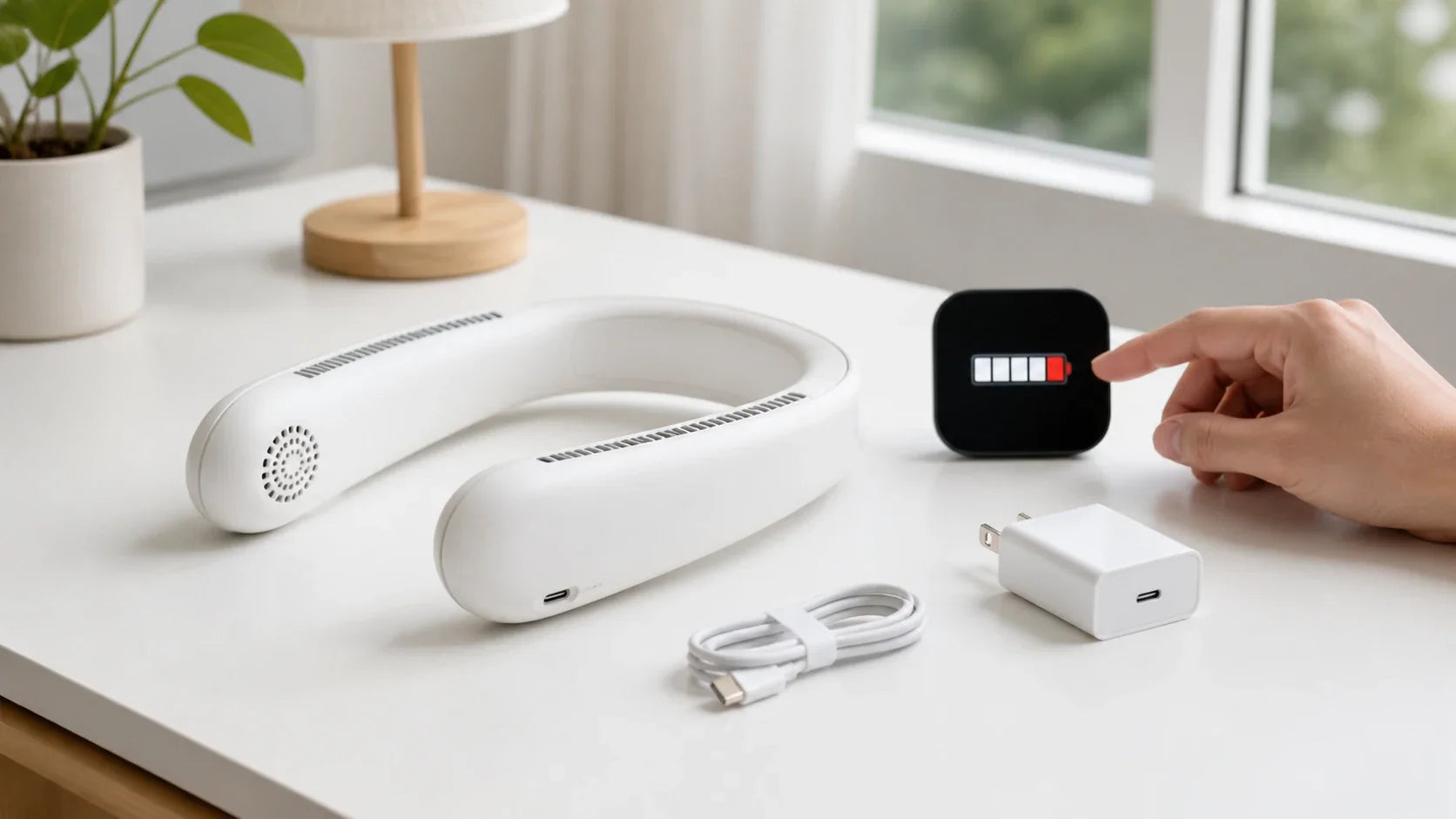
Weigh the product as worn. Measure noise on every mode. Test runtime from a full charge.
Record whether the cooling level drops as the battery falls. Note any hot spots, pinching or airflow blockage during walking.
The result should answer a consumer question: will this product remain comfortable and useful during the intended activity?
What happens in humidity, still air and high heat?
Weather can change the result more than a new fan setting.

In high humidity
High humidity slows sweat evaporation. A fan may still move air and improve comfort. The evaporative part of the effect can become less efficient.
An active cooling plate does not depend on sweat evaporation in the same way. It can still create a cold contact sensation. Its hot side must still release heat to the surrounding air.
Humidity can also increase condensation risk if a plate falls below the local dew point. Follow the product’s cleaning and moisture instructions.
Do not assume that active plates make the entire device independent of climate. Fan airflow, heat rejection, skin moisture and fit still matter.
In still air
A neck fan creates its own local airflow. This can be useful in a crowded train, a quiet room or a windless queue.
The result depends on clear vents. Hair and clothing can quickly reduce the useful flow.
Still air also makes hot-side design more important for thermoelectric models. The device must move its rejected heat away from the heat sink.
In very hot air
Fan-only devices move ambient air. If that air is very hot, the benefit becomes less predictable.
Research using larger fans has found that air movement may become ineffective or harmful in some hot, dry conditions. The exact boundary changes with humidity, clothing, age and sweat response.[3]
A neck fan has lower airflow and much smaller coverage than the systems in those studies. Do not use a single room-fan threshold as a safety rating for a neck fan.
Use the conservative rule instead. If the environment feels dangerously hot, move to a cooler place. Use shade, hydration and local heat guidance. Do not extend exposure because your neck feels cool.
During exercise or hot work
Exercise creates metabolic heat. Protective clothing can trap heat. Sun and hot surfaces add radiant heat.
A consumer neck fan may improve comfort. It cannot manage every source of heat strain.
NIOSH treats personal cooling as one possible part of a wider workplace program. The program may also need acclimatization, work-rest schedules, hydration, engineering controls and emergency procedures.[4][5]
Workers should follow their employer’s heat plan. They should not replace it with a retail wearable.
Are neck fans worth it?
A neck fan is worth it when its mechanism matches your goal.
| Your main need | Best starting choice | Why | Watch for |
|---|---|---|---|
| Hands-free comfort at a desk | Quiet fan-only model | Low weight and long runtime can matter more than maximum power. | Motor tone, airflow near papers and dry eyes. |
| A hot commute | Fan-only or hybrid model | Airflow helps during walking and waiting. Plates add a clear contact sensation. | Weight, hair clearance and conversation noise. |
| Humid sightseeing | Hybrid airflow plus cooling plates | Contact cooling is less dependent on sweat evaporation. | Battery use, condensation and carrying weight. |
| Long fan runtime | Fan-only model | Fans usually need less power than thermoelectric cooling. | Runtime claims may use the lowest setting. |
| A strong cold sensation | Active-cooling neck air conditioner | Cooling plates can feel colder than room air. | Plate contact, hot-side heat, pressure and high-mode runtime. |
| Running or hard exercise | Start with route, timing and heat planning | A neck device has limited coverage and can bounce during movement. | False confidence, blocked awareness and heat-illness signs. |
| Hot work with PPE | Employer-selected heat controls | The task needs a full heat-risk assessment. | PPE compatibility, workload and emergency procedures. |
| Cooling a bedroom or office | Room air conditioner or building cooling | A neck device does not lower room temperature or humidity. | Energy use, ventilation and room size. |
Before buying, answer five questions:
-
Do you want airflow or a cold surface?
-
How much weight can you tolerate on your neck?
-
Will the vents stay clear around your hair and clothing?
-
How long must the selected mode run?
-
Is the goal comfort, or are you trying to manage hazardous heat?
If the last answer is hazardous heat, start with a safety plan. Do not start with a shopping list.
Frequently asked questions
Do neck fans lower body temperature?
They can lower temperature at parts of the neck or face under specific conditions. They should not be assumed to lower core body temperature. A 2025 neck-cooling trial found a stronger cool sensation without a significant core-temperature difference.[2]
Do neck fans work in humidity?
They can still improve local comfort, but humidity reduces sweat evaporation. Active cooling plates may provide a more consistent cold contact sensation. Actual results still depend on air temperature, fit, airflow and activity.
Are cooling plates better than fans?
Cooling plates are better when you want a cold surface on the skin. Fans are often lighter and run longer. A hybrid model offers both effects but usually adds weight and power demand.
Do neck air conditioners blow cold air?
Most use ambient air for the fan outlets. Their thermoelectric plates create the colder surface. Do not assume the air itself has been refrigerated unless a product test measures outlet air below ambient under a defined load.
Are neck fans safe to use all day?
Follow the manufacturer’s instructions. Take breaks if you feel pressure, skin irritation, numbness, dryness or unusual heat from the device. Keep hair, fabric and debris away from the intakes.
Can a neck fan prevent heat stroke?
Do not rely on a consumer neck fan to prevent or treat heat illness. Move to a cooler place and follow local medical or workplace guidance if symptoms appear.
The bottom line
Neck fans really can work for personal comfort. Fan-only models move ambient air. Active-cooling models add a cold contact surface.
The strongest evidence is for local sensation and local skin effects. The evidence does not support treating a cool neck as proof of a safer core temperature.
Choose by mechanism first. Then compare fit, weight, noise and runtime in the mode you will actually use.