

















A swollen gland under your jaw is most often caused by a blocked saliva duct, usually from a salivary stone, or by an infection in the gland. Less often, a growth or an immune-related condition is the reason. If the swelling gets worse when you eat, that is a strong clue that saliva is backed up behind a blockage.
Seek emergency care if the swelling grows quickly, you have trouble breathing or swallowing, or you cannot open your mouth normally.
How Submandibular Swelling Happens
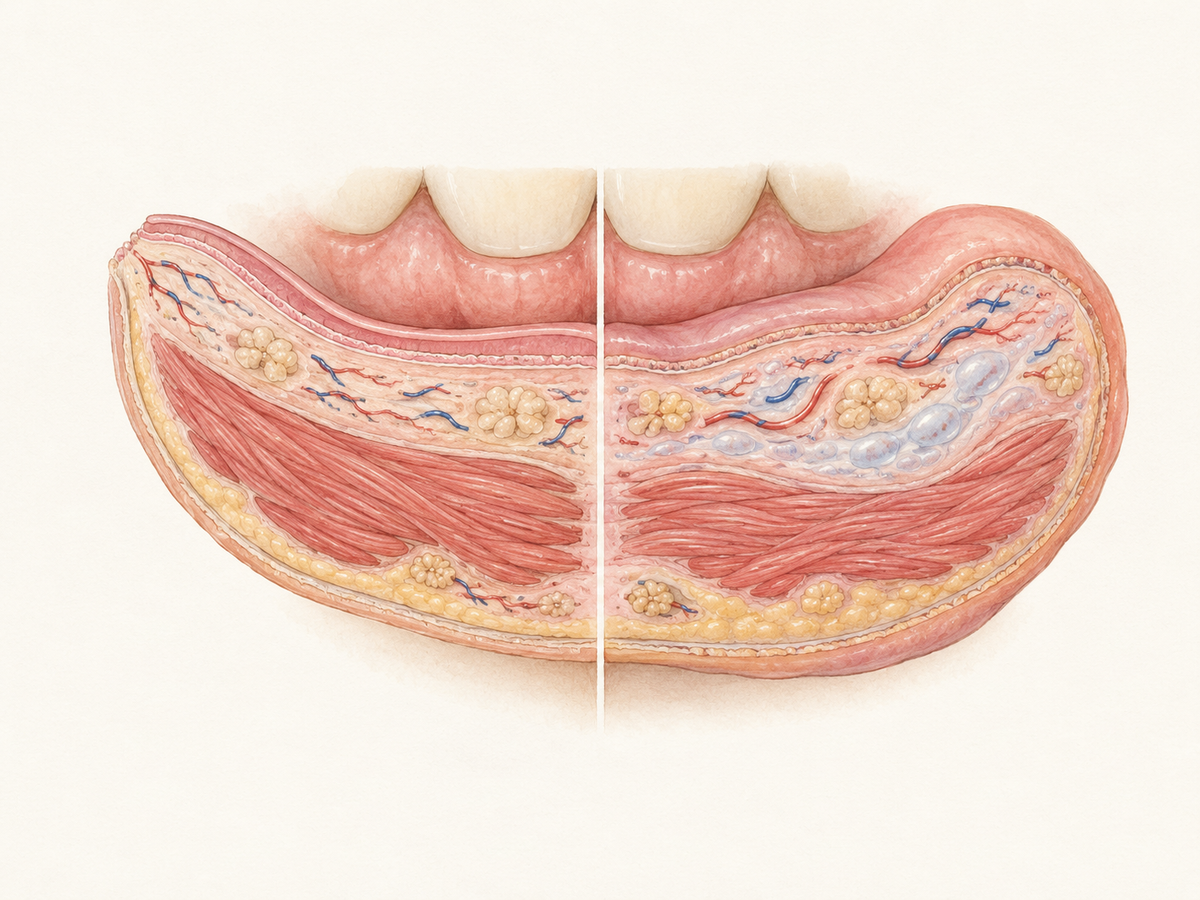
You have two saliva-making glands under your jaw, one on each side. These are the submandibular glands. Each one empties saliva into your mouth through a small tube called Wharton’s duct, which opens under the front of your tongue.
This gland is prone to blockages. Its duct is long, and saliva has to travel slightly upward against gravity to drain. The saliva is also thicker and contains more minerals than saliva from some other glands. Those features make stones more likely to form there, according to clinical guidance on salivary gland disorders.
Swelling can happen in three basic ways:
- Saliva flow gets blocked, so fluid backs up into the gland.
- The gland itself becomes inflamed or infected.
- A lump or immune-related process makes the gland tissue larger.
These mechanisms explain why the same swollen area can come from very different causes.
Common Causes: Stones, Infection, and Duct Problems
The most common cause of submandibular swelling is a salivary stone, also called sialolithiasis. A stone is a hard mineral deposit that forms inside the duct. It blocks saliva flow, so the gland swells during a meal and may slowly go down over the next couple of hours. Salivary stones account for about half of major salivary gland disorders and affect the submandibular gland in 80–90% of cases, according to clinical guidance on sialadenitis.
Bacterial infection often develops behind a blocked duct. When saliva sits still, bacteria can multiply. The most common bacterial culprit is Staphylococcus aureus. This can cause a sore gland, fever, and sometimes pus at the duct opening under the tongue.
Viruses can inflame the gland too. Mumps is the best known, but influenza, HIV, and coxsackievirus can also cause salivary gland swelling.
Other blockages can act like stones:
- A stricture is a narrowed section of the duct.
- A mucus plug is a sticky blockage that can stop saliva flow.
Common clues of a stone, duct problem, or infection include:
- Swelling that appears or worsens when you eat
- A feeling of fullness or pain under the jaw during meals
- Tenderness when the area is pressed
- Fever or feeling unwell
- Pus or cloudy saliva from the duct under the tongue
Other Causes: Tumors, Autoimmune, and Systemic Conditions
Less often, swelling is not from a stone or infection. A growth inside the gland can cause a lump. Salivary gland tumors can be non-cancerous or cancerous. Submandibular masses are more likely to be malignant than parotid masses, so a lasting lump should be checked. But a lump does not automatically mean cancer.
Some immune-related conditions can enlarge the glands:
- Sjögren’s syndrome often causes dry eyes and dry mouth along with gland swelling.
- IgG4-related disease can cause firm, often painless swelling under the jaw.
- Sarcoidosis, an inflammatory disease, can involve the salivary glands.
Other health issues can also play a role. Diabetes, eating disorders, and certain medications can reduce saliva flow or affect gland function. Unlike stones, tumors and immune-related swelling often:
- Do not change much with meals
- Are painless or only mildly uncomfortable
- May slowly get worse over weeks or months
See a clinician if you have a persistent, painless, or growing lump, especially if you also have dry eyes, dry mouth, neck lumps, or unexplained symptoms.
Red Flags: When Swelling Is an Emergency
Most submandibular swelling is not an emergency. But a deep neck infection can spread quickly and threaten the airway. Ludwig’s angina is a serious infection under the jaw and floor of the mouth that can make breathing difficult.
Get emergency care if you have any of these:
- Swelling that grows rapidly or feels hard and spreading
- Fever with severe pain
- Trouble breathing or swallowing
- Drooling because swallowing is hard
- Trouble opening your mouth fully, also called trismus or lockjaw
- Redness spreading across the neck or floor of the mouth
- Feeling very weak or dehydrated
These signs may point to an abscess, cellulitis, or Ludwig’s angina. Do not wait for a routine appointment.
How Doctors Find the Cause
The evaluation usually follows a step-by-step path.
First, the clinician will ask about the timing, meal-related swelling, pain, fever, dry eyes or mouth, and any medications. Then they will examine the face, neck, and inside of the mouth. They may press gently on the gland and check saliva flow from Wharton’s duct. Cloudy saliva or pus can point toward obstruction or infection.
If a stone or infection is suspected, ultrasound is usually the first scan. It can show stones, widened ducts, or an abscess. If more detail is needed, CT or MRI may be used. CT is often better for deep infection or an abscess, while MRI gives a closer look at the gland tissue.
Sialendoscopy uses a tiny camera to look inside the duct. It can find and sometimes remove a stone during the same procedure. If a growth is suspected, the doctor may recommend a fine-needle biopsy or tissue sample.
Treatment Options by Cause
Treatment depends on what is causing the swelling, not just the swelling itself.
- Bacterial infection: antibiotics, fluids, warm compresses, and saliva stimulants.
- Salivary stone: removal through sialendoscopy, lithotripsy to break up the stone, or surgery. Sialendoscopy is successful in more than 8 out of 10 people with stones, based on a systematic review of sialendoscopy outcomes.
- Duct narrowing: widening with sialendoscopy or, if narrowing keeps coming back, surgery on the duct or gland.
- Autoimmune disease: treatment to calm the immune system, usually guided by a specialist.
- Tumor: surgery, sometimes followed by radiation or other cancer treatment.
Recurrent obstruction may need surgery to fix the duct or remove the gland. This is usually considered after simpler treatments have not worked or the gland is badly damaged.
Home Care and Prevention
For mild, non-emergency swelling, you can try these steps while arranging care:
- Drink enough fluids.
- Apply a warm compress to the outside of the jaw for 10–15 minutes.
- Gently massage the gland from back to front, using light pressure.
- Suck on sugar-free sour candy or lemon drops to stimulate saliva.
- Keep up with regular brushing and flossing.
These measures help keep saliva moving.
Do not use strong pressure or heat if you have fever, severe pain, spreading redness, or a possible abscess. That can make an infection worse.
Prevention focuses on staying hydrated, managing conditions such as diabetes or dry mouth, and getting recurring meal-time swelling checked before an infection develops.
Questions to Ask Your Doctor
- What is the likely cause of my swelling?
- Is this more likely a stone, infection, or something else?
- Do I need an ultrasound, CT, MRI, or biopsy?
- What treatment do you recommend, and what are the risks?
- When should I follow up or seek urgent care?
If your symptoms are mild and you feel well, start with these questions at a regular appointment. If you have any red flags, go to urgent or emergency care.
This article has been reviewed by an oral health professional for accuracy. It is intended to provide general educational information and should not be used as a substitute for personalized medical advice, diagnosis, or treatment. If you have questions or concerns about your oral health, please consult a dentist, physician, or other qualified healthcare provider.